Terrain that fights back
Natural scree, real gradients, snow patches and weather that changes inside an hour. No set dressing, no reset button.
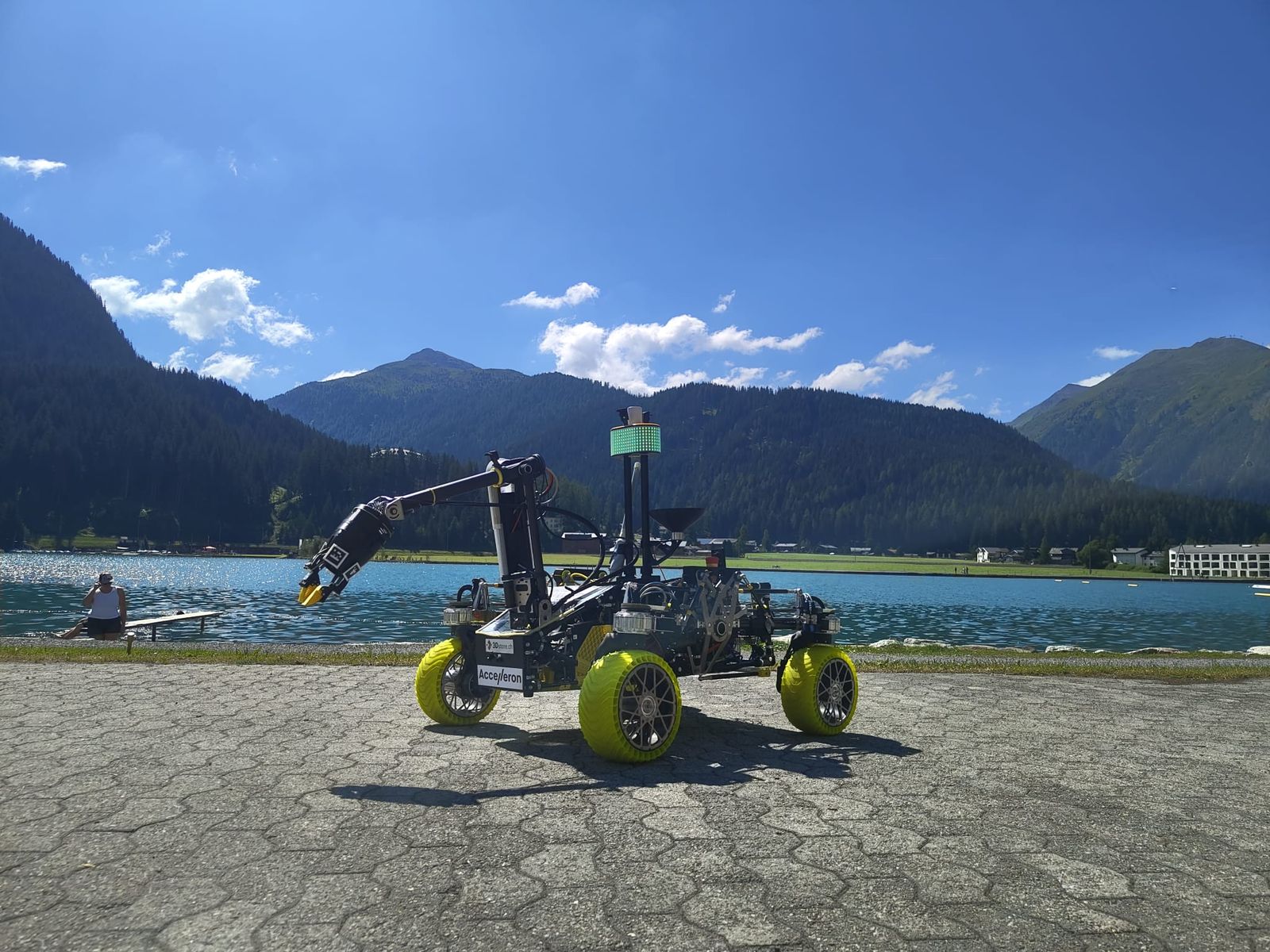
Real mountains. Not a Mars yard.
A robotics competition set in genuine alpine terrain above Davos, Switzerland — planned alongside the Davos Tech Summit. Student and research teams bring rovers and drones out of the sandbox and into a mountain that does not cooperate.
Non-binding — it tells us how big to plan and keeps you on the list.
Why another rover challenge
The European Rover Challenge runs on a constructed Mars yard of roughly 30 × 30 metres. The University Rover Challenge uses the Utah desert; CIRC uses Canadian flatland. The Alps are already there — steeper, colder, less predictable, and effectively unbounded.
Natural scree, real gradients, snow patches and weather that changes inside an hour. No set dressing, no reset button.
Potentially the largest competition area in Europe. Distances that make autonomy a requirement rather than a bonus category.
Aerial scouting of terrain a rover cannot reach — the emphasis of this first edition, not an afterthought discipline.
Planned alongside the Davos Tech Summit: teams meet industry, researchers and investors instead of only each other.
We are in conversation about tasks written by organisations that do this work for a living in these mountains.
Organised by the crew behind the FHNW Rover Träff, which has grown from 3 teams in 2023 to 8 in 2026.
The disciplines — draft
An adaptation of the established rover-competition format to open alpine terrain, with autonomy and aerial support carrying more weight. Final task definitions will be published with the official rules.
Cross broken, unmarked terrain autonomously. Long distances, GNSS you should not fully trust, and no smooth path anywhere.
Scout what the rover cannot reach. Survey a target zone, feed it back, and make the ground vehicle smarter for it.
Collect rock and soil samples from native alpine ground — not a prepared sandbox with buried props.
Take measurements in the field, then interpret them. The analysis counts as much as the sampling.
Operate real equipment: panels, switches, connectors — mounted on genuine mountain infrastructure.
Pitch your system to a jury drawn from the summit. Engineering is half of it; explaining it is the other half.
Draft schedule
A working outline while dates are being fixed with the summit. Competition day is planned for the Saturday so it lands with the summit's public programme.
Location
The Schatzalp area is our working assumption: reachable terrain, workable logistics, and close enough to town that spectators and summit guests can actually get there. Other sites in the region are under evaluation.
For teams
We are sizing the first edition right now, and the number of teams that raise their hand directly shapes the format, the budget and the pitch to sponsors. This is not a registration and commits you to nothing.